Chanukah Christmas cage match

An open letter to retailers on the cusp of Christmas shopping season:

I know you have been waiting since July to debut your newest and biggest product. I know you held off as long as you could until the very end of September to start marketing the pants off of it.  And I appreciate that.  Even if you could not resist starting Black Friday sales on Thanksgiving Day, I still love your holiday season.  Though I don’t celebrate Christmas, I can’t get enough of the lights, the Bing Crosby and Nat King Cole music, the chance to wear sequined anything at parties.  I don’t have to worry about the decorations, the gift-buying stress, the meal planning, extra travel, none of it.  It’s a fabulous tradeoff.

This is the first year, however, that my older daughter will remember everything about the Christmas season.  She is close to four years old, and we can’t dodge her thoughtful questions as well as we did last year.  She notices everything, can’t stop talking about anything.  I can’t prevent her confusion about the Christmas tree situation.  I accept this. But she will wonder about the presents she sees everywhere we go–is that what Christmas is really about anyway? This insane conspicuous consumption?

Oh, and please also spare my daughter the confusion of whether Chanukah is the same holiday as Christmas.  It’s not.  It’s okay if you don’t market to me or my family. I’m not sure why you think Chanukah is the opportunity to market anything blue (like dishes or napkins) and call is Jewish.  It’s nice to see a platter flecked with Stars of David, but I’m not running out to set the perfect Chanukah table.  That’s not a thing. We celebrate a holiday that is less relevant in the scheme of things to our own religious and cultural life than Christmas.  In fact, I am not even sure when giving gifts became such a big deal for American Jews because Chanukah was not always a gift giving holiday.

Rest easy, retailers. Chanukah will be over 9 days before Christmas. We won’t get in the way of your sales strategies, trying to maximize every last liquid cent in our bank accounts.  We don’t care if there is a puny little menorah on your holiday display. And lay off the Chanukah cookies, please!

Besides, on this festival of lights, we eat donuts anyway.

Posted in being jewish, family, holidays | 3 Comments

Being thankful (and a little glib)

It is already the middle of November. I wanted to write this post right when the month began but we were understandably busy, standing down a storm and preparing for political winds to change.  Here we are, one week away from Thanksgiving.

November is the month of Thanksgiving (kind of like how October is the month of Halloween and Breast Cancer Awareness). This month, more than every other month, we give thanks for the things we have. We make gestures of charity to those in need. We recount a vague history of the first Thanksgiving meal.  We make these days so precious—gathering together with loved ones, inflating the market for turkeys, and over-eating.  We make the chances for Thanksgiving so scarce by bemoaning their importance only in November.

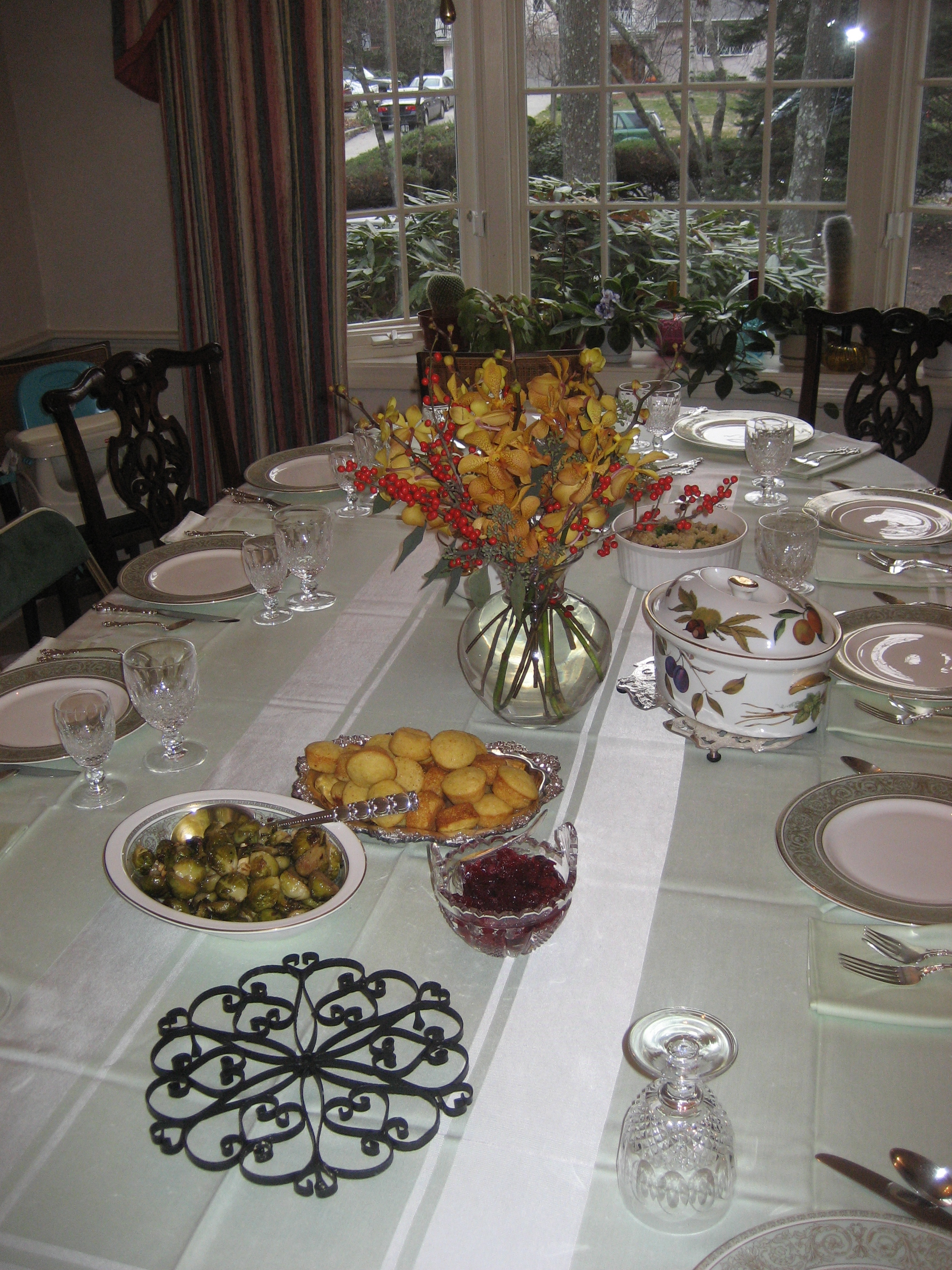
Hometown Thanksgiving table

Even though I sound cynical, Thanksgiving is and has always been my favorite holiday. My parents and grandparents were married on Thanksgiving, so our holiday meal always felt extra celebratory.  Thanksgiving was really the way our families began.  Growing up, I knew that these Thanksgiving meals together would not necessarily last forever.  Life could get complicated and maybe one day, I would have to be away from my parents’ dining room table and the people I loved so very much.  How could Thanksgiving feel as special without them? Then life got more complicated.  After college, I moved further away from my parents. My sister, a registered nurse, had to work on Thanksgiving.  I started dating and eventually married someone who lived hours away.  As newlyweds, we had to make decisions about where to spend the holidays. My sister married too, and coordinating when we would be home together for Thanksgiving got to be complex. My mom passed away. Celebrating together made us realize someone was missing.

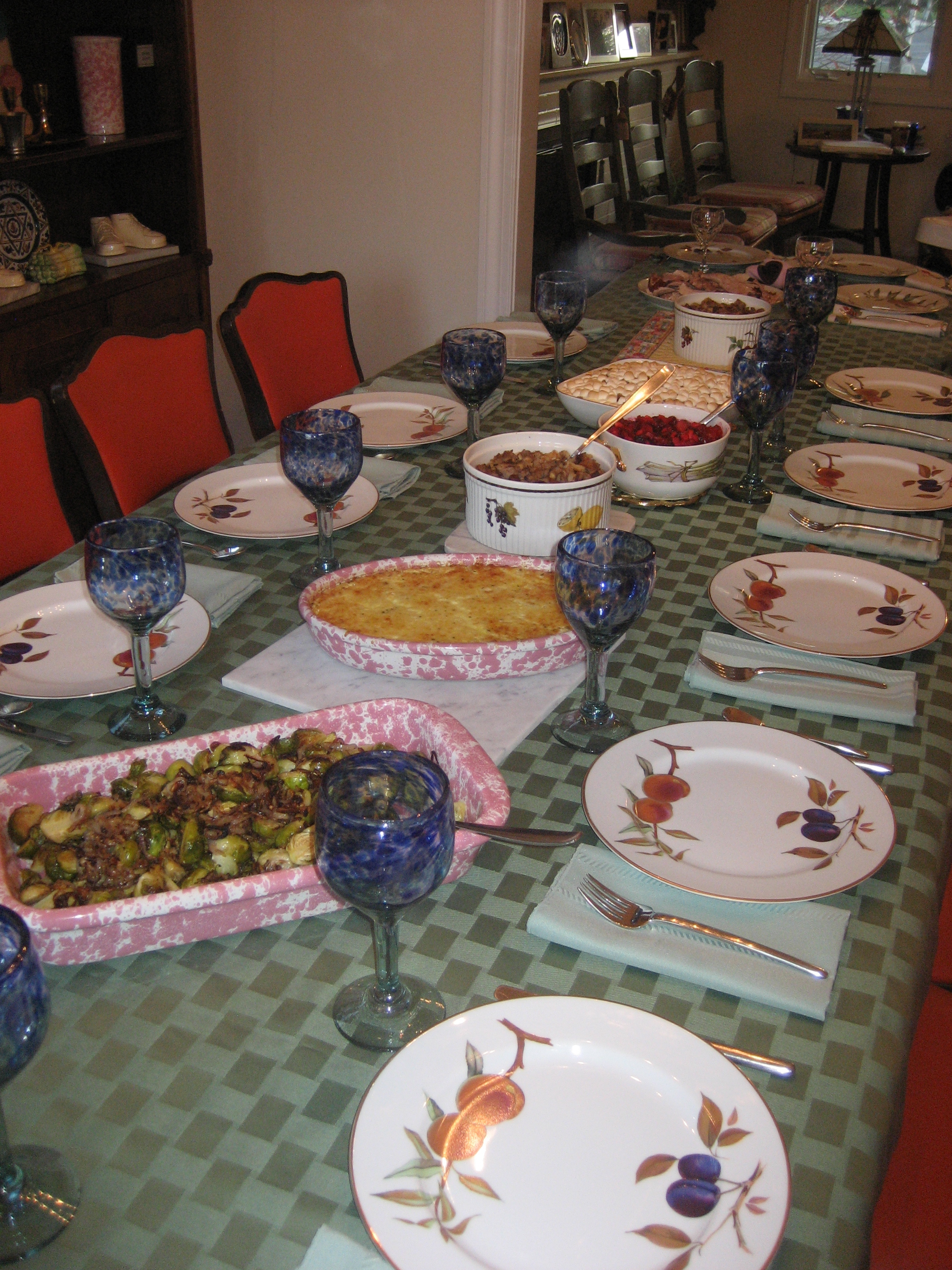
Away game Thanksgiving table

I always felt as though these Thanksgiving days were precious, like we could never be as close as family on any other day.  Those were the musings of a naïve young lady.  I have my own family now and still travel to the home of a parent or family member for the Thanksgiving.  I have a schedule now—one year with my family and one year with my married family (cross-referenced with my sister’s own family so we are all still together every other year).  But I don’t think of these days as precious anymore.

But it is not on Thanksgiving that I give thanks for what I have.  I do it every day. (Ask my husband—I think it might drive him crazy.) I look at my partner, at my children, at my family, my friends. It’s glib, but we have so much to be thankful for.  Just one month of thanksgiving is simply not enough.  Like other “awareness” months and charity campaigns, more so than ever, our holiday season in this country shines a light on those in need, and shuts them out when the New Year begins.

This month, I am hoping to teach my daughter about thanksgiving always, and not simply in November.    At three, she understands that we have food and others don’t.  “So we have to help them,” she tells me.

Now to help her understand that turkey the bird is the same as turkey the food.

Posted in family, food, holidays | 1 Comment

something personal

Some days, I’m not thinking sociologically.

On grey Wednesdays (like today), I wish it were a sunny Sunday so I could hang with these faces.

That is all.

Posted in family, kids, marriage, motherhood, parenthood | 1 Comment

exercise your rights and please vote

According to the U.S. Census, 58.2 % of registered voters actually cast ballots in November 2008. That figure is on par with rates of voting in the 2004 election and only slightly higher than the election in 2000.  That means one-third of the country’s population does not vote.  As a country, only 2/3 of our eligible population shows up for the only day when we count.

This past weekend, I had a amicable and active conversation with my father-in-law regarding the upcoming election. My father-in-law, a fiscal conservative and a social moderate, seemed unsure of who to choose. (Side note: I still find the concept of being undecided pretty baffling, but I could see his struggle.) Politically speaking, my father-in-law and I sit on opposite sides of the aisle.  After our animated discussion of our party’s candidates, we reached a dead heat.  No one was winning this debate.

He told me that he was thinking of “sitting this one out.”

I looked at him and I said, “I don’t think you should vote for Romney. But I do think that you should vote.  In your state which is democratically leaning, please consider voting for a third party candidate.” He agreed.

There are lots of ways that our election may shake out.  No matter what we think the outcome might be, we should still vote. It’s the only stake we have in this complex system.

Vote.

Please.

Thanks for reading.

Posted in community, culture, economy, gender equality, health, higher education, marriage, politics, Uncategorized, work | Leave a comment

evidence-based rant about parenting and fatherhood

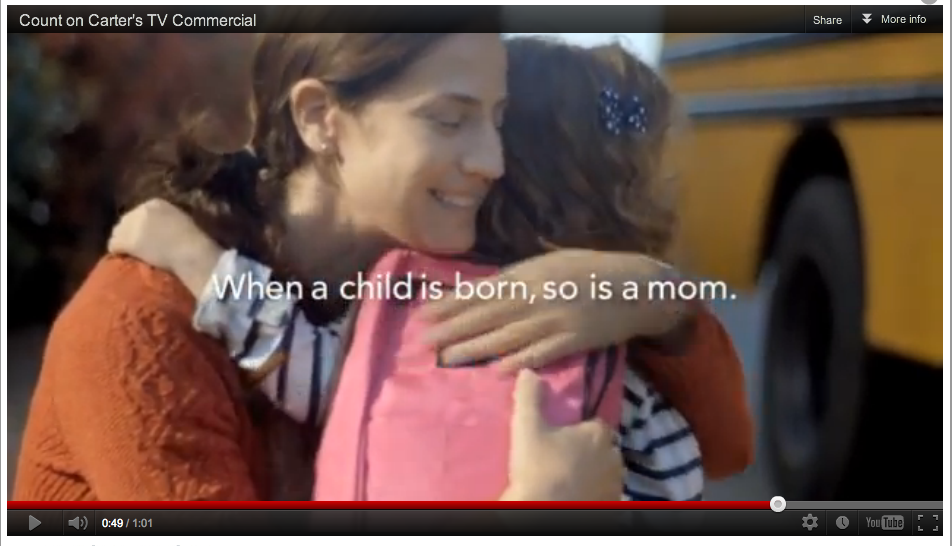
One fun aspect of having daughters: the cute clothes they get to wear.  My favorite outfits for the girls have always been Carter’s brand because the prints are completely precious and besides the cute-factor, they are really durable.  Carter’s hardly ever advertises on television, but the other day I was surprised to catch an actual commercial—I have to admit that I first saw the ad while the sound was muted so I did not hear the little girl narrator meant to tug at my heartstrings. Spoiler alert: it worked.  That is until the very end of the ad when I saw this tag line: “When a child is born, so is a mom.” 

I’m more than just a little bit curious. When a child is born, only a mom is born? Only a mom? I turned to my husband and said, “I thought when a child was born, that’s when you became a dad.” He nodded in approval mostly to appease me because he knows tag lines that deprecate fathers (and parents of all kinds) annoy me.  This sort of emotional pandering by just about every company out there exhausts and infuriates me. I’m just getting over the P&G Summer Olympics campaign that basically credited only moms with the success of Olympic athletes.  What about the fathers?  Better yet, why not credit parents in general and not just mothers?

In this country, family forms have changed drastically in the last few decades.  There is research to support that while our definition of family might still be traditional, we are beginning to recognize other forms of families, specifically same-sex partners with children.  Many people become a family through adoption and are not present for the birth of their children—this applies to heterosexual and homosexual partners.  This Carter’s commercial reifies all kinds of assumptions about what makes a family and what we can expect from our mothers and fathers, primarily that families only count if they have one mom and one dad.  In these families, the mothers are selflessly devoted to their children while the dads are barely present.  When the dads are present, they are bumbling, not to be trusted, and idiotic.  This same script appears in TV sitcoms, in B-movies, and in everyday life, because it’s rare that anyone challenges it.

I want to rant about how society expects less from fathers (even if fathers believe that parenthood is worth it no matter the cost or work associated with it). Sure, I’m frustrated that as a society we expect less from fathers and because we expect mothers to be the primary parent. In a recent New York Times Parenting Blog post, one dad wondered why we call women with professional lives outside of the home “working moms” but we never refer to men as “working dads.”  But, it’s more than our low or nonexistent expectations for fathers. To assume that only mothers parent or that companies should be the “proud sponsors” of moms, means that we think parenting is the same as mothering and the only valid families are those with a mother at the helm.

Why do we assume that I know anything about parenting just because I’m a mother?  As a new mom, I can tell you that I knew nothing.  I stayed very calm and I was lucky that I had a very adaptable baby.  And after several weeks of mothering, I actually fell in love with my older daughter.  It was nothing like the experiences described in docudramas or movies–I did not instantaneously fall in love with our little girl.  It was gradual, and several years later, I continue to fall in love with her a little more each day.

You would think that I had this mothering thing down with the birth of my second daughter, right? I mean, all sources indicate that mothers have this mothering situation under control. Wrong wrong wrong. Our second daughter was the polar opposite from the first. At around six months, my sleep-deprived husband and I looked at each other and agreed that we were no better off that night than the first night we came home from the hospital.  But we stayed as calm as we could, got as much sleep as we could, and fifteen months later, we are still muddling through.

The narrator in the Carter’s ad ends by saying, “The day I became yours, you became mine.” Isn’t this the kind of ethos we should be promoting?  Families grow out of all kinds of circumstances.  Not all family making is left to mothers. Not all families even have mothers. As family life gets complicated, we’ll have to find ways to represent all kinds of families and give all kinds of parents their due. I stand by the realization I made in my earliest days of parenting. Clean clothes and emotional support are the most important things new parents (and families) need. It’s a washing machine and a partner (and a whole lot of love and detergent) that make the family.
Posted in family, fatherhood, gender equality, kids, marriage, motherhood, parenthood | 5 Comments

a little gratitude for meteorologists

It feels like I am the only person on the east coast who is relatively calm about this impending weather event.

It’s Sunday evening in the Northeast and if you hadn’t already heard, a hurricane is on its way. For almost a week, we have been receiving warnings, updates, advice, and information about how to prepare and what to expect if and when the storm actually hits us.  At first, the stream of information about the storm was coming at me from many directions and as I capped off another incredibly busy work week, the idea of getting prepared felt overwhelming and nerve-wracking.

It’s no wonder people in the Northeast are worked up.  This time last year a storm was headed our way, but no one anticipated a snow storm at the same time.  No one could have predicted up to ten days without power.  The day after the October storm hit, we had planned to celebrate our new baby daughter and were expecting family and friends to join us. Instead, the power was out for eight straight days.  And eight days without power is a long time. Because no one was prepared for the aftermath of the storm, it was disastrous. The power company made promises it could not keep, people felt frustrated and hopeless, and the landscape looked apocalyptic in places.

Even though we knew the power would return, not knowing when we’d be back on the grid was disconcerting.  Every day that passed, I tried to remind myself that in other places in the world, access to reliable power and dependable infrastructure is tenuous at best.  We have skilled professionals trying to keep us safe AND trying to predict the forces of nature.  If they get it right, they’ll be heroes and if they miss the mark, we will eventually get over it.

This storm might be a different animal.  It could wage even greater destruction that last year’s storm.  And somehow, I’m still pretty calm. We have groceries, clean laundry, and our phones are charged.  This year we have even more time to prepare and even better information.  We’ll ride this one out.

And if all else fails, I’ve got a cousin with a generator.

Posted in culture, family, weather | Tagged | Leave a comment

empowering my daughters 100%

I am raising two daughters in this world. And I am scared for them. I have followed the presidential election campaign since the spring from the very start of the Republican primaries and I feel troubled by the rhetoric that by now has become so stale, I don’t even hear it.

The candidates have focused almost entirely on the state of our national economy at the expense of discussing other issues facing the nation. And in this economy, women are at a disadvantage. We earn less than men and always have. Little public discourse had addressed gender inequality in earnings. As a nation, we are focused on the haves/have-nots because the system is so out of balance.  However, even if a more equitable regulatory environment, even in an improved and healthy economic climate, women are still at a disadvantage. Improving class inequality does not improve gender inequality.

Ladies, rise up? Is this our moment to make our vote count?

When the media addresses the involvement of women in the political process, they reduce their engagement to rhetoric that sexualizes them. “Courting” women or “turning women off” have become standards of the political lexicon in both conservative and liberal media outlets. So even if women want to engage in these issues, their contributions will not be considered serious.

And the political machine is ill-informed about women in general. Besides the fact that women remain under-represented in elected positions, those who do represent us, often misunderstand us. Akin’s downright ridiculous commentary on sexual assault and the denial of scientific evidence around issues of women’s reproductive health is beyond concerning. In the presidential debates, the word “women” is hardly mentioned except to reference half baked attempts at equity in gender representation in the workplace. Binders full of women simply won’t do.

So I fear for my daughters. The political discourse does not allow for space to discuss social policies like marriage equality or family leave that would address the struggles that many women and men face in the workforce.  I have to rely on their plan for the economy alone to make my decision. And no matter what plan I choose, women are still valued at 70% of their male peers. It is a losing proposition.

Last night, I took my three-year-old daughter with me to a meeting at the liberal arts college where I teach. I want her to see higher education (and education broadly) as a pathway to success. I don’t want to feel like I’m lying to her that no matter how much time or money she invests in her education, that no matter how smart she is, that she will always be worth 30% less than her male peers. I want her to believe that she can be anything she wants to be and that her effort will be valued 100%.

Posted in economy, gender equality, politics, women, work | Leave a comment

Parenting super highs

I am not going to pretend like I am the first person to ever have children in graduate school because I am certainly not. I am also not going to pretend like I’m the first academic working parent who chose to write about the topic.  My blurry personal and professional lines were breached the other day and the experience felt blog post-y to me.

Having my daughters has made me a better professional. When I am on the clock, I aim to be more organized, myopically focused, and terribly ambitious because my work time is both limited and flexible.  Besides ruthless efficiency in the office (or in the coffee shop as it were), my family provides a counterpoint to what I study and write day in and day out.

I don’t even think about my own situation—it works for our family and me and I am pushing hard to get finished with my dissertation in the coming months.  But, I was reminded of my current work/life arrangement when I sat in on a panel last Friday about securing external funding as a graduate student.  The grant I received was far less competitive or generous than those received by the other two women on the panel, but I happily waxed poetic about the proposal writing process and encouraged the new students to put their work–and thus themselves–out there in the sociological world.  Don’t wait until you feel like you have something to say, I told them. That’s what I did and I regret not being more ambitious early on.

After the panel, the other two advanced graduate students and I were chatting and the discussion moved inevitably to my kids.  They asked how they were doing and humored me while I shared news about their comings and goings.  And then came the script I have heard many times before.

“I don’t know how you do it. I can barely take care of myself.”

I am forced on the defensive to first confirm that having kids makes me more efficient and that not having kids is fine, too.  I always throw a line about work/life balance because having a family forces me to unplug and spend time with them. And at the end of the day, when my analysis isn’t panning out or a student is giving me a hard time, I see their little faces and work melts away.

I drove home, still slightly troubled by the exchange. I can’t tell if I should feel good about having a reprieve from work when I’m with my family or if I’m once again being judged for having a personal life at all.  Besides the exchange, I have had a serious case of writer’s block.  My husband picked up the kids, so I could pretend to keep writing.  I kept listening for the slam of the car door in the driveway, signaling the end of a long week.  My curly-haired three-year-old daughter bounded into the house and announced that our toddler had taken a few steps at school.  And then I saw my baby girl take steps for the very first time.

Nothing at work can match seeing your own child take their very first steps.  Seeing those wobbly little legs and the determined smile on her face made me forget that I pushed a self-imposed deadline back and didn’t meet the subsequent follow-up deadline. It made me forget what I study or write.  It made me feel like a super hero.

Posted in academia, kids, motherhood, work, writing | 1 Comment

Get Your Pink On. Or off.

I’ve already made it clear that I cannot escape sports in my house, especially baseball and football.  During that magic time of year when the baseball post-season overlaps with the early NFL season, it is impossible to ignore what’s happening in professional athletics.

On this football Sunday, I was actually holed up in my office working on my dissertation analysis, so I avoided much of the action on television until late afternoon when the Patriots game was on in the background.  And the players were wearing hot pink.  Hot. Pink.  I thought maybe there had been a modification to their uniforms or something (though I know professional uniforms are somewhat sacred). Looking closer, I saw players were wearing pink arm bands, shoes, waistbands, hats. This could not be related to breast cancer and the Komen Foundation, could it?  One player had even shaved the breast cancer ribbon into his hair.

The stunt was part of NFL Pink, a campaign co-sponsored by the NFL and the American Cancer Society to fight against breast cancer.  And since October is Breast Cancer Awareness Month, it seemed fitting that on this first Sunday of the month players got into the breast cancer fighting spirit by showing solidarity and donning hot pink anything.  This trend to “raise awareness” via clothing, buttons and the like has likely been written about in the popular press.  However, this display is particularly troubling for several reasons.

First, while breast cancer (all cancer really) is a terrible disease, it is not the only disease plaguing women.  In fact, according to the American Cancer Society’s Cancer Facts and Figures 2012 report, more women die from respiratory (lung) and digestive (stomach) cancer than they do from breast cancer.

These cancers aren’t as sexy as breast cancer, it seems. Lung and stomach cancers share the same “awareness” month—November.  Somehow, I don’t see awareness campaigns about these cancers competing with Thanksgiving and Christmas marketing on the national stage.  Websites providing lung and stomach cancer support and resources show no grand plans to raise awareness in the month of November compared to the NFL Pink campaign.

Beyond the inequity in awareness of more deadly cancers, there is the inequity in funding resources to detect breast cancer at all.  The Susan G. Komen Foundation, like the NFL, is using the month of October to sponsor “pink party” fundraising events around the country.  However, the money raised by Susan G. Komen for the Cure is not fully funneled back into treatment and services.  Though they do sponsor research grants, they also spend more on their Race for the Cure related programs than they do on Health Screening services.  After the organization first pulled and then restored funding to Planned Parenthood earlier this year, I find it extra appalling that more money does not get funneled into the organization that performs actual screening and detection.

All the inequities aside, football is a violent sport. Do I feel inspired to action by watching grown men dressed in hot pink tackling one another?  Using violence to incite awareness is equally distressing as using sex to “raise awareness” as breast cancer organizations did two years ago during the month of October.  Is this display meant to galvanize the masses who worship in the stadium on Sunday?  In the end, calling this show of solidarity “awareness” makes supporting the cause feel cheap.

Posted in culture, health, sports | Leave a comment

I know I’m old.

It was confirmed to me yesterday while teaching and meeting with students.  I should not be surprised by these interactions.  I am not in the same age cohort as my students.  In fact, I could even be their parent (if things in my life had been very different).  Even still, feeling old is a sign that one day, I may be out of touch with my students.  And I do not like that prospect.

The evidence indicating I am old:

First, in my lecture on theories of learning, I was talking about Pavlovian conditioning.  I wanted to give an example of a signal (not a bell) that could elicit the same biological reaction as salivating. (Remember Pavlov’s dogs—ring a bell and the dog salivates? It was a boon for psychology folks studying animal behavior).  I did preface my statement with, this may not be your generation, but has anyone ever had a beeper?  They immediately started laughing.  Laughing.  I explained how serving as an administrator on call at two colleges and having carried a beeper on and off for three years, I still have a rush of adrenaline when I hear the beeper alert.  They sort of got it.  I should have consulted the 27th item on Beloit’s Mindset List (a list of the “cultural touchstones” salient for each college cohort) that cites the “outdated” (and perhaps ironic) icons on their smart phones and tablets—a floppy disk for “save” and an actual phone for “call.”

Then, in a conversation with a student, she described her conversations with other “adults” and the word adult clearly applied to me.  I am an adult.  Clearly.

And finally, in an uncomfortable meeting with a student about his work, I had to get super serious about his progress this semester.  I told him he wasn’t working up to his potential (something only adults can say) and that I expected more from him (see last parenthetical aside).  Later on, that student emailed me to thank me for the proverbial kick in the backside.  That only happens when someone older than you tells you like it is.

Data triangulated from several sources. I am old.  And guess what? I would not trade my current life for another go at college for anything.  Being old is supreme.

Posted in academia, work | 2 Comments