No typical work day

Today was not your typical work day.  Then again, I rarely have a typical work day.

7 a.m. The usual morning lineup. Breakfast with preschooler while little munchkin slept. Note to self: must start feigning extra hour of sleep by wearing footie pajamas.

8:30 a.m. Out the door and on the way to main campus where I started the day doing some final data polishing for my dissertation project.  That was the morning.  I got hungry around 10:30 and ate my peanut butter and jelly sandwich.

1 p.m. Relocated to my usual coffee shop and spent some time there before I had to pick up the preschooler for her dance class.

3:45 p.m. Dance time. While the preschooler danced, I continued to plug away in a lounge at the JCC.  Post-dance class, hit the post office and got dinner on the table for the family.

6p.m. Headed to girls’ night out (without the going out part).  Met some friends for appetizers before they went to a movie and I went to the public library to work some more.

At 9 p.m., I returned home and retired to our couch until my laptop battery finally gave out.  And here I am at our desk, still working.

I set up my makeshift laptop office 5 times today, parked in two parking decks, drank three cups of coffee, and I’m still not quite happy with the status of my work.  How is it that I have been working on this project for months upon months and a looming deadline makes me look like a scrambling undergrad?

Posted in academia, dissertation, grad school, procrastinating, work, writing | 5 Comments

We were on a break!

Academic breaks are an awkward time for us scholars. With only 15 weeks in the classroom every semester, there is little time to escape, little chance for a “vacation” day. Academic breaks are a time to recharge and to play serious catch up.  Even with a serious work ethic, the two to three weeks in December and January feels like little chance to get my bearings.

There may be no “face time” commitment except for errant committee meetings, but we’re working furiously on our own projects, prepping for meeting presentations, and maybe, just maybe, taking time for ourselves.  Ask anyone in my life and they will tell you that I have been camped out at my local coffee shop working like crazy, writing, editing, and trying to get this dissertation finished.  Every day, I see that self-imposed deadline of year-end 2012 moving further and further away, and every day I’m clamoring to keep it in sight.  Let’s not even talk about how my spring 2013 course is. not. prepped.

There are plenty of people writing about the general misunderstanding of the academic lifestyle.  I have to fully restrain myself when anyone asks me if I’m “on break” as if that somehow means I’m not working.  In fact, I’m so furiously working, that I refused to take off New Year’s Eve day and would have worked on New Year’s Day if my in-laws had not visited for the afternoon.  My husband reminded me that January 1st “is a holiday after all.”  My response, “My work knows no holiday.”

Now, I know I’m not curing cancer.  I am fully aware of that.  I do study school inequality and it’s an issue that knows no calendar.  But when you work for yourself (and one of my mentors pushed me to treat my work like running my own business), the harder you work, the more you accomplish.  What’s frustrating is that you can work hard and still struggle to prove your worth on that CV (a discussion better saved for a future blog post). Sure, there are plenty of tenured people out there who kick back over Christmas and in the summer because they are “on a break.”  I have tried to treat this non-face time as serious work time.  And because I’m at the end of my dissertation writing, I see a light at the end of this long, long tunnel.  I want this project finished.  So I’m hungry to get. it. done.

I was wondering about the cyclical nature of other jobs.  Teaching cannot be the only job with a cycle to it.  Accountants and financial people see the same ebb and flow of work with quarter-end, year-end urgency.  Do people ask them whether they’re “on a break” now that April 15th or their year-end mark has passed?

Having worked in academia in some capacity for over ten years now, I am thankful for the flexibility that my profession affords me.  I get plenty of time with these faces and I have found a way to establish sufficient work/life balance.  But, when anyone asks me if things are quieter because I’m “on a break,”  I’ve taken to replying, “what break?”

Posted in academia, higher education, holidays, schools, work, writing | 3 Comments

Non-resolutions for 2013

Day 2 of the new year.  I have always been a resolutions kind of girl.  Some years have been very specific like “Stop biting my nails” (an ongoing battle).  Other years, they have been grander like “Be focused” (I think this related to both work and personal life).  I have always had relatively healthy habits so I figured I could stick to resolutions I made, but like the best resolutions, most fizzled by spring.

This year, making resolutions seems to be in conflict with a new style of working I’m trying to adopt, Zen To Done (ZTD).  Zen to Done is nothing new–I’ve been trying to work simply, efficiently, and cleanly for as long as I have been a working person.  However, in the Zen to Done philosophy, you focus on only one goal at a time.

While I have plenty of personal goals, my only professional goal right now is to finish my dissertation.  So professional resolution, check.  Under the ZTD philosophy, once you’ve completed your goal, you make a new one.  And believe me, I have plenty of professional goals on the proverbial back burner right now.

As for personal non-resolutions, I just want to re-establish some healthy habits I used to have.  I used to exercise with regularity and now I make excuses.  I used to menu plan to alleviate dinner-time stress and now I just throw something together.  These little things make a difference in my personal life.  So instead of a life overhaul (in resolutions), I just want to slowly slowly re-establish the routines and strategies that make my life easier.

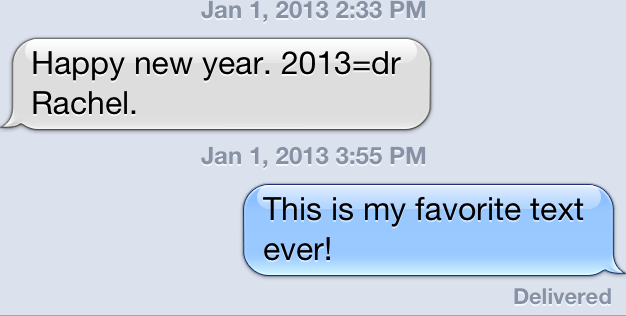
I got the best text ever on New Year’s Day from a good friend.  I feel a palpable energy and excitement in the air and luckily it seems like I have lots of support around me too.

Text messageBig things are happening this year.

Posted in blogging, food, health, holidays, personal, work, writing | 7 Comments

A healthy dose of fear (and why I quit downhill skiing)

It’s official. I am not a downhill skier.

Snow capped treesAfter my fourth lesson this past Sunday, I finally decided that downhill skiing is not for me.  I understand the physics of it and I’m physically fit enough to actually do it, but I simply cannot get over the fear of going fast (and falling down and breaking my leg).  I felt fearful after my very first lesson years ago, and my husband told me it’s something I would simply have to get over if I wanted to get better.

Intellectually, I understood.  A healthy dose of fear can be a good thing.  And this past weekend, as I stared down the little bunny slope, I had this thought, “You don’t have to do this.” As we mastered the snowplow down the little practice hill, I thought to myself, “I would rather be dissertating than skiing right now.”

Now, THAT’S saying something.

When I got to the bottom of the bunny hill, I didn’t even want to walk down the rest of the hill.  With the lesson was over, I marched right into the rental shop and turned in my skis.  I strained my shoulders sliding my feet out of the boots.

It bothered me for days.  I am not a fearful person, so why couldn’t I just get over it?  I’ve been in plenty of fear-inducing situations in the past.  After the fated ski lesson, I took on several crazy water slides at an indoor water park.  I love roller coasters.  I have even jumped out of a plane.  I like a good adrenaline rush, but this fear was different.

Giving in to the fear meant quitting something.  And I am not a quitter.

I think that’s why I remain disappointed.  I was reminded of what it’s like to quit something, and because I can’t even remember the last time I quit anything, I can’t shake this feeling of disappointment.  I have overcome this healthy dose of fear in my professional life lots of times.  I do it almost daily as I work on my dissertation.  So I know it can be done.

I needed to find a skiing alternative. Sure, my dreams of family ski vacations faded on my only run down the bunny hill that day.  But in their wake, a new outdoor winter passion was born: snowshoeing.

BlissSnowshoeing is a revelation! It’s like walking, but with ridiculous footwear.  And when you snowshoe, you get the peace of season with less risk of bodily harm.

I have found my new happy place.

Posted in family, personal, travel | 3 Comments

On grief and Newtown.

While I have not lost a child in tragic and violent circumstances, I have lost someone unexpectedly and suddenly.  And more than sorrow and heartbreak, the grief of Newtown families is palpable to me.  I live in Connecticut, and I feel their grief in the air. Like people across the country, I feel it in my heart.

Six years ago, I lost my mother in a car accident.  She was a pedestrian struck by a car on a Wednesday in April.  I was in my first year of graduate school. That day, I was in a theory seminar discussing post-modernism. I made chicken piccata for dinner.  The phone rang, an accident.  I remember everything and nothing of those initial weeks of loss.  I remember all of the details of our drive to the hospital but once we arrived and heard the news, time stood still.  I remember the funeral.  The swarm of faces and the din of voices rang in my ears for days.  We sat Shiva for a solid week and I barely rested. For a long time, I held that grief in my bones.

Grief is a powerful emotion. If you’ve never experienced gut-wrenching grief, it is hard to explain how eviscerating it can be. It’s like an assailant in hot pursuit of your happiness. One moment, you feel almost normal and the next, something happens and you’re in its clutches.

During that first year without my mom, I would avoid anything that I thought would make me sad.  No more hospital dramas.  No violent movies.  No car accident imagery. No mother-daughter events.  I censored anything that I thought would trigger grief or sadness.  No amount of self-censorship could have prepared me for the moments when grief overtook me.  It was unpredictable and no matter how much I tried to protect myself, something unexpected would happen and there was the grief, sweeping over me, crushing me.

Until I lost my own mother, I had always wondered how people survived the tragic loss of a loved one.  I talked about my grief with a loving therapist, with my sister, and with my husband.  I was very private about it.  My therapist showed me that grief is debilitating but it can also be empowering. After months of weekly therapy, she helped me to see that I could succumb to the grief I was feeling or I could dig deep and survive it myself.  While I can’t think of any specific instances now, I am sure there were times that I thought I could not survive it.  But I learned about this reserve of personal strength.  It’s there.  I just had to tap into it.

It’s simply impossible to assume that everyone’s grief is the same.  The worst thing someone said to me after I lost my mother was “Been there, done that.”  I assume that this person had lost a parent, and at the time, I remembering thinking to myself, “No one can know exactly what I’m feeling.”

I do not, will not, and hope I never have to fully understand first hand the grief suffered by parents of Newtown children or the family members of Newtown teachers.  When communities suffer a tragedy like this, when communities lose so many people, the best we can do as a larger society is give them space and support.  When loss is so tragic and so public, the grief feels shared, but it’s not. Knowing a little about grief, I am sad any family has to endure it.  I wish I could tell the Newtown families that it gets easier.

In light of last week’s events, I have heard people vow acts of kindness to one another, vowing to honor the memories of the victims.  I am hoping this sentiment will carry forward into the new year.

In the meantime, be gracious and smile.  It’s all we can do.
Posted in blogging, family, health, kids, personal, schools | 1 Comment

You only write your dissertation once

Thankfully, in academia, you only write your dissertation once.

Thank. goodness.

Most graduate training is oriented towards research and writing, but the art of research and writing is less evident in the formal curriculum.  And if your graduate training has shaped you into a confident and competent scholar, you have still never written a dissertation.  A dissertation is unlike other products of research and writing like journal articles or books.  If you’re fortunate to have good mentors (which I am), then the process of writing your dissertation feels like cobbling together separate but related articles or book chapters that you could easily modify after you are “finished” your dissertation project. But the dissertation project looms in front of any doctoral student like a giant moose you’re supposed to tame.  Moose-tamer is not a job I expected to do in grad school.

This semester, I have been co-instructing/observing an undergraduate senior research seminar.  The course is run much like a master’s level academic research workshop where students have their own research projects and where we work through the finer issues of scholarly research from collecting and analyzing the data to writing up and presenting one’s findings.  Teaching this class has been the best personal learning.  Much of learning how to do academic research happens by actually doing it, making mistakes, and fine tuning your skills for your next project.  You can take a class in research methods or about some specific subject, but synthesizing the two is not always straightforward.  It is truly an art, and teaching others to do has made me a better scholar.

It’s been easier to approach my own dissertation project as I contextualize different parts of the research process for my students.  For instance, I will admit that writing a literature review has never been my strong suit.  I understand the broad literature but figuring out where I fit has always been a challenge for me.  There is a serious breadth and depth of literature in the sociology of education (education in general, really).  Maybe I have felt like I could always read more or cover more of the literature in my review.  Maybe I’ve been pressed for time and could not review as much as I wanted to.  Maybe I’ve been hesitant to take a stand in my own research.

But who says you have to write that part first?  With my dissertation analysis mostly finished, I finally know what the project is about.  Writing the literature review for my dissertation proposal, how could I know what to highlight, what to hold back, or what to critique?  I had a sense of the holes in the broader fabric of knowledge but felt unsure of my critique.  I have always struggled with this part of research because I have always tried to write it first. As the project nears completion, I can see more clearly where it fits into the broader literature.

Something about my dissertating and my teaching experience this semester has emboldened me with a new confidence, though. When I sent that last analytical chapter to my advisor, I didn’t know whether to celebrate or cry.  I know being “finished” the writing does not mean that I am actually “finished.”  In academia, you are never really finished anything.  So now I am back to reviewing literature and fine tuning the theory and literature chapter.  The moose is getting a little easier to manage.

Posted in academia, dissertation, grad school, procrastinating, work, writing | 3 Comments

Faux dissertation acknowledgements….

I am trying to lock down this final analytical chapter of my dissertation.  There is always more to write, edit and adjust with the project, but I am aiming to have a full draft together by the end of the calendar year.  That’s 24 days away.  I want to start 2013 in full editing mode.  I have enough work and life responsibilities on my plate without adding additional pressures, but I am pushing ahead.  In the face of pressure, it’s easy to start procrastinating like I am by writing this post or to do what I do when I get extreme writer’s block.

I break out my dissertation acknowledgments.

I know, I know.  It’s putting the cart before the horse, but it gives me a little hope that I may actually (one day very soon) be finished with this project.  The actual acknowledgements are meant to be formal, so I like to imagine who really belongs in that list if it didn’t look totally unprofessional to include them.

And here they are:

The usual fuel

The usual fuel

I owe a debt of gratitude to the Hartford Baking Company.  I composed much of my dissertation while enjoying your mocha coffee, your light, fluffy ginger scones, and your incredible salami and provolone sandwiches.  I am especially thankful for your furnishing of the café with completely uncomfortable chairs, and for your tolerance of local academics camping out all day in caffeine-fueled stupor.

Source: http://www.tumblr.com/tagged/doc-mcstuffins

Thank you, Chris Nee, for creating Doc McStuffins. You have given the world a quality children’s program that showcases a little girl of color as a doctor. It’s good for the world. It’s good for my girls.  And it makes me feel much better about parking the girls in front of the TV when I am frantically throwing together dinner after a day of teaching and dissertating.

Thank you to Tangiers and Harry’s Pizza.  The falafel and pizza that have graced our dinner table far too often this semester have been delicious.  At the end of long days when I could not possibly handle making dinner, you had it covered so I could couch out with my girls, watching Doc McStuffins.

Thank you to Comcast for changing all of my TV channels two months ago. It was hard enough to remember three-digit numbers, but you made it more complicated by giving us four-digit channel numbers.  I have no brain space to remember my favorite channels and have never bothered to learn the new ones.  At the Leventhal-Weiner house, TV watching is on the decline and thus productivity is on the rise.

Thank you to #phdchat and Twitter followers from afar. Your #dissertation progress inspires me. Your #research frustrations validate my own struggles. I appreciate the e-community of grad students and early career professionals sharing tips, tricks, and knowledge.  #Gradlife is almost over for me and I have enjoyed watching others on their professional journeys.

Source: http://www.nytimes.com/2010/11/24/arts/music/24nicki.html

Source: http://www.nytimes.com/2010/11/24/arts/music/24nicki.html

And finally, thank you to Ke$ha for your incredible Pandora radio station. You’re blowing up in the media for your “flirty playfulness.”  Your Pandora station brings Nicki Minaj into my life soundtrack as well. Without the two of you, the Methods chapter never would have happened.

Back to the grind…

Posted in academia, dissertation, grad school, work, writing | 4 Comments

Will an extended school day raise all boats?

Yesterday, Secretary of Education Arne Duncan, announced an initiative to expand the school day in 10 school districts across 5 states, affecting over 17,000 kids. My home governor, Dannell Malloy, was present in Washington, D.C. for the announcement because three CT districts (East Hartford, Meriden, and New London) are included in this pilot program.

I have been an academic (in-training) for too long because when I first heard this announcement on WNPR, I immediately wanted to see the evidence guiding such a massive decision. State educational leaders, the National Center on Time and Learning and the Ford Foundation share the responsibilities for both implementation and funding of this pilot program, yet no one pointed to any evidence or research in the announcement. Not until much later last night did I discover that Secretary Duncan had tweeted a link to a report released by the National Center on Time and Learning this past April that reviews “evidence” of the benefits of an extended school day. If this is how policy decisions get made, we all have our heads in the sand.

The report, “The Case for Improving and Expanding Time in School: A Review of Key Research and Practice,” is a meta-analysis, and though I expected to see original research, I continued to read. Author Farbman provides rationale for extending the school day by citing studies of extended school time and by linking these findings to potential improvements in the existing curriculum. There are three flaws in the logic of this report. First, much of the cited research touting the benefits of a longer school day pre-dates NCLB. Six of the studies that found positive relationships between extended school day and improved student outcomes were published before the year 2000 (two date back to the 1980’s and one to the 1970’s). No doubt, the experience of education is quite different for students who have been raised in a technological age. Additionally, the report relies heavily on the academic improvement experienced in charter schools. While charter reformers have always hoped that strategies employed by choice schools would drive competition in the broader system, the population of both teachers and students/families engaged with charter schools is self-selected and thus slightly inappropriate evidence for a broad-sweeping national reform strategy such as this one. Finally, the report conflates an extended school day with an extended school year or even improvements in learning over the summer. If this reform is based on recovering hours in the day, then success in schools with a longer school year or success achieved over the summer should not factor into the equation.

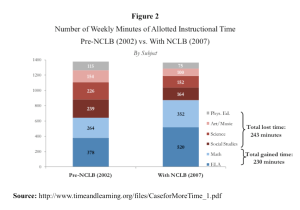
Lost Instruction Time, Pre-NCLB v. Current Day

Lost Instruction Time, Pre-NCLB v. Current Day

The report does provide a compelling illustration of lost instructional time since the implementation of NCLB. If added instructional time revives arts programs or vocational classes, that would be a boon for educators in those disciplines. These are the very classes that keep struggling students engaged with school life. The rhetoric of the announcement still seems focused on tests and assessments.

An extended school day attends to struggles of young families including the need for quality child-care. If additional school time brings back arts, music, shop class, or even recess and physical education, then I think there are real possibilities here. It may, however, mean that we’re simply cramming more time in the day to prep for the CMT.

Time will tell….

Posted in schools | Leave a comment

Things I Wish Someone Had Told Me in My First Year of Graduate School

As I get closer to the finish line, I now seem to qualify as an “advanced” graduate student.  I sat on a panel this week for the first year students in my grad program. I didn’t voice these things verbatim, but here’s my advice (that I nearly always heeded).

Things I Wish Someone Had Told Me in My First Year of Graduate School

1. Always be learning

  • Things you hate doing are actually learning. Learning opportunities are not just the time spent in courses.  It’s the job talks, the colloquium talks, the informal chatter in the hallways.  You see good presentations or terrible presentations—internalize what worked in those situations.  Don’t avoid the chance to network with people in the department.  You can learn from them, too.
  • Teaching is some of the best learning. I cringe when I hear other grads decry their teaching responsibilities. Yes, grad student labor is a huge issue, however, it can be hard for some grads to get teaching experience. Teaching keeps you on your toes and forces you to organize your time because you can’t just phone in a 50-minute class. Teaching has been a great opportunity to stretch myself intellectually.  I have to know a lot of information, be ready to present it, and field student questions on the fly. Teaching keeps me sharp, engaged with the field and with current events. And often, I improve my own work because I have to model the work for my students.
  • Make your work work for you. Double dip on anything you can to maximize your exposure and experience.  Use course papers to prep future journal articles (this is what most people advise).  But beyond that, find conferences and send abstracts of work that’s not yet finished. If they get accepted, then you have a self-imposed deadline. Notes from a seemingly irrelevant class I TA’d years ago fit right into that lecture for my survey class.  Just don’t do work twice—I typed these notes to myself and I’m using them as a blog post today.  I did the work so I might as well get something out of it.

2.  COMPARTMENTALIZE & ORGANIZE: Not having a brick and mortar office with a time clock to punch affords me serious freedom and flexibility with my schedule. It takes serious dedication to report to yourself every day, stay focused all day, and get things accomplished when no one is looking over your shoulder.  Two things to remember:

  • To help stay focused, I compartmentalize my schedule. Teaching prep/teaching activities happen on teaching days. Writing/research happen on non-teaching days. If I am not in a position to have full days dedicated to teaching or writing, then I block off consistent time on my calendar.  And I stick to it.  Once you get into a schedule, work that schedule. Don’t sabotage yourself by making appointments or having lunch or procrastinating.  Getting into a schedule groove can take time and will change from semester to semester.
  • To get organized, I use several technological applications to help keep myself together.  Bookends for reference management, Evernote for cataloguing ideas, and Twitter for sharing/engaging with colleagues.  These tools have helped me streamline my workflow and keep me from distracting myself. Add your course readings to Bookends (or other ref software), keep notes and ideas in Evernote and use Twitter to connect with others and stay current in the field.

3. Your professional life is happening RIGHT NOW–not in five years or after you’re done with your comps.

  • Take every opportunity out there to get into the field whether it’s attending a conference, presenting your work, or engaging with colleagues.  Don’t wait until you think you have something to say. Just get out there—you’ll feel more confident, you’ll start to make connections, and you’ll feel like colleagues rather than “just a grad student.”  Through social media (Twitter and blogging), I have found great support and have formed e-colleagues. Don’t worry about embarrassing yourself or making mistakes, just get in the game.
  • There are ways to do good sociological work outside of the academy.  The nature of higher education is changing. The job market is tough. Don’t be afraid to find models for what you want to do.  And be honest with your mentors. They want the best for you and they know when something is not a good fit.
  • Down time is relative. No, we don’t get “summers off.”  And while finishing a project is reason to celebrate, it’s not time to simply drop the ball for several weeks. As you near completion on one project (a chapter, an article, the semester), start planning what you’ll spend your “newfound” time on before your schedule opens up. Transitions out of and into every semester can be a serious adjustment, so make it easier on yourself by planning ahead.  My advisor says you can reasonably accomplish three things in a summer. So be realistic.

4.  Your personal life matters: Whether you’re destined for it or not, the pursuit of professional superstardom comes at a cost. Eating well, sleeping, exercising, and mental health time all fall by the wayside easily at the beginning of graduate school. And even if you don’t expect it, life can change in 5 or 6 years.  While in graduate school, I lost my mom unexpectedly during my first year, bought a house, had two kids (in my third and fifth years), and am negotiating a potential move out of our current house. My family gives me balance and motivates me to be excellent at what I do because in my mind, my work makes the world better for those two little girls. You will feel pressure to put work first and like any other industry, you’ll have to make choices about how you allocate your time.  Life does not stop because you’re getting a PhD, and you still have to find ways to make your personal life a priority.

I had so many thoughts, so I distilled it down as much as I could.

What did I miss? 

Posted in academia, higher education, teaching, work, writing | 13 Comments

On the importance of original thoughts…

I do my writing in a local coffee shop.  When I’m sitting in their uncomfortable aluminum chairs eating fluffy scones and sipping the house blend, I wrestle with my keyboard. I drudge up ideas, type some thoughts, erase them, start over, delete delete delete, and kvell over a paltry two-hundred and fifty words.  Striking the save key is the greatest triumph.  My chosen profession means I’ll be writing about injustice in society, and I’m fine with that because I am a writer.  That’s what I’ve always wanted to be.

On those coffee shop days, I would never dream of borrowing another person’s words and fitting them in with my text, aligning their style with mine, and misappropriating their voice for my own. I could not imagine anyone doing that, but it happens all the time.  I’m seeing it increasingly in my teaching with students, and I wonder why they resist thinking for themselves and resort to using someone else’s thoughts.

We give the current generation of college students far too much credit when it comes to technology.  Digital tools have always been part of their educational experience but that does not mean they are tech savvy.  The plagiarism I’ve caught has been but a google search away from discovery.  Little subterfuge, it seems, is necessary.  Yet, somehow, students feel like this is an appropriate solution for poor time management, misunderstanding the assignment, or worse, good old-fashioned laziness.  In a survey of 1,055 college presidents in the US, the Pew Center found that over half of them report plagiarism in student work is on the rise and close to 90% of them say the internet and technology are involved.  It’s a thing.

And the plagiarism industry is certainly not new.  Paper writers for hire have probably been around as long as professors have been assigning papers.  Just for kicks, I searched for term papers online and discovered that there are actual sites distributing papers for free!  Some scholars, though, are tired of playing bad cop, and I am with them. But then, should we look the other way?

As a sociologist, I often wonder about the social construction of rules or laws. People decide the norms, and people decide on the sanctions for those who breach the norms. The process has a social component.  In this case, think your own thoughts, or suffer the consequences.  The consequences of plagiarism are also socially constructed, and full of red tape, I might add.  Simply ignoring instances of plagiarism would make my professional life less stressful, but ignoring them also makes a mockery of my professional life.  If I can simply use another person’s intellectual property as my own, what’s it all worth, anyway? In another industry, like the recording industry, battles are waged over a small riff in a musical interlude, whose voice is dubbed, or who performs live in concert.

Academia is no different from any other creative industry. Dishonest academics steal intellectual property all the time.  Sometimes they even steal from their graduate students.  For shame.

Posted in academia, higher education, teaching, work, writing | 2 Comments